VATICAN: Presentation of the Logo for the ‘Year of Consecrated Life’
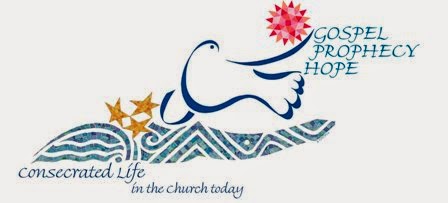
The Logo for
the Year of Consecrated Life expresses through symbols the fundamental values
of consecrated life. In it we recognize the “unceasing work of the Holy Spirit,
who in every age shows forth the richness of the practice of the evangelical
counsels through a multiplicity of charisms. In this way too he makes ever
present in the Church and in the world, in time and space, the mystery of
Christ” (VC 5).
the Year of Consecrated Life expresses through symbols the fundamental values
of consecrated life. In it we recognize the “unceasing work of the Holy Spirit,
who in every age shows forth the richness of the practice of the evangelical
counsels through a multiplicity of charisms. In this way too he makes ever
present in the Church and in the world, in time and space, the mystery of
Christ” (VC 5).
In the lines
that outline the form of the dove one can intuit the word ‘Peace’ in Arabic:
this is a reminder that consecrated life is called to be the model for
universal reconciliation in Christ.
that outline the form of the dove one can intuit the word ‘Peace’ in Arabic:
this is a reminder that consecrated life is called to be the model for
universal reconciliation in Christ.
The dove: is the classical symbol of the action of the Holy Spirit, who
is the source of life and the inspirer of creativity. This is a flash-back to
the origin of history: in the beginning the Spirit of God moved on the waters
(cf Gen 1,2). The dove, gliding above a sea swollen with yet unexpressed life,
symbolizes a patient and hope-filled fecundity, while the symbols around it
reveal the creative and renewing action of the Spirit. The dove also evokes the
consecration of the humanity of Christ through baptism.
is the source of life and the inspirer of creativity. This is a flash-back to
the origin of history: in the beginning the Spirit of God moved on the waters
(cf Gen 1,2). The dove, gliding above a sea swollen with yet unexpressed life,
symbolizes a patient and hope-filled fecundity, while the symbols around it
reveal the creative and renewing action of the Spirit. The dove also evokes the
consecration of the humanity of Christ through baptism.
The waters: are made of mosaic fragments;
they indicate the complexity and the harmony of the human and cosmic elements
that are made to “groan” by the Spirit according to God’s mysterious plans (cf
Rom 8, 26-27) so that they may converge into the hospitable and fruitful
encounter that leads to a new creation. The dove flies among the waves of
history, above the waters of the deluge (cf Gen 8, 8-14). The men and women,
whose consecration was marked by the Gospel, have always been pilgrims among
the nations; they live their various charismatic and diaconal presence like
“good administrators of the multiform grace of God” (1Pt 4,10); they are marked
by the Cross of Christ, even unto martyrdom; they journey through history
equipped with the wisdom of the Gospel; indeed, a Church that embraces and
heals all that is human in Christ.
they indicate the complexity and the harmony of the human and cosmic elements
that are made to “groan” by the Spirit according to God’s mysterious plans (cf
Rom 8, 26-27) so that they may converge into the hospitable and fruitful
encounter that leads to a new creation. The dove flies among the waves of
history, above the waters of the deluge (cf Gen 8, 8-14). The men and women,
whose consecration was marked by the Gospel, have always been pilgrims among
the nations; they live their various charismatic and diaconal presence like
“good administrators of the multiform grace of God” (1Pt 4,10); they are marked
by the Cross of Christ, even unto martyrdom; they journey through history
equipped with the wisdom of the Gospel; indeed, a Church that embraces and
heals all that is human in Christ.
The three stars: These stand for the identity of
consecrated life as confessio Trinitatis, signum fraternitatis e servitium
caritatis. They express the circular relationships found in the Trinitarian
love, which consecrated life is called to live daily in the world. The stars
also hint to the triple halo used in the Byzantine iconography to honor Mary,
the Mother of God, the first Disciple of Christ and model and patron of every
consecrated life.
consecrated life as confessio Trinitatis, signum fraternitatis e servitium
caritatis. They express the circular relationships found in the Trinitarian
love, which consecrated life is called to live daily in the world. The stars
also hint to the triple halo used in the Byzantine iconography to honor Mary,
the Mother of God, the first Disciple of Christ and model and patron of every
consecrated life.
The polyhedral globe: The small polyhedral globe
symbolizes the planet with its myriad variety of nations and cultures, as
explained by Pope Francis (cf EG 236). It is the breath of the Spirit that
sustains it and leads it towards the future: an invitation to all consecrated
persons “to become bearers of the Spirit (pneumatophoroi), authentically
spiritual men and women, capable of endowing history with hidden fruitfulness”
(VC 6).
symbolizes the planet with its myriad variety of nations and cultures, as
explained by Pope Francis (cf EG 236). It is the breath of the Spirit that
sustains it and leads it towards the future: an invitation to all consecrated
persons “to become bearers of the Spirit (pneumatophoroi), authentically
spiritual men and women, capable of endowing history with hidden fruitfulness”
(VC 6).
The Headword
Vita consecrata in Ecclesia
hodie Evangelium, Prophetia, Spes
hodie Evangelium, Prophetia, Spes
(Consecrated life in today’s
Church Gospel, Prophecy, Hope.)
Church Gospel, Prophecy, Hope.)
The headword
provides a further highlighting of the identity and prospective, experience and
ideals, grace and journey that consecrated life has lived through and is still
living within the Church as people of God, as it journeys together with the
different nations and cultures toward the future.
provides a further highlighting of the identity and prospective, experience and
ideals, grace and journey that consecrated life has lived through and is still
living within the Church as people of God, as it journeys together with the
different nations and cultures toward the future.
Evangelium: this indicates the fundamental
rule of consecrated life, which is the “sequela Christi as taught by the
Gospel” (PC 2a). First of all as “a living memorial of Jesus’ way of living and
acting” (VC 22), and then as vital wisdom in the light of the multiple counsels
that the Lord gave to his disciples (cf LG 42). The Gospel shows the way ahead
and is a source of joy (EG 1).
rule of consecrated life, which is the “sequela Christi as taught by the
Gospel” (PC 2a). First of all as “a living memorial of Jesus’ way of living and
acting” (VC 22), and then as vital wisdom in the light of the multiple counsels
that the Lord gave to his disciples (cf LG 42). The Gospel shows the way ahead
and is a source of joy (EG 1).
Prophetia: reminds us of the prophetic
character of consecrated life, which “takes the shape of a special form of
sharing in Christ’s prophetic office, which the Holy Spirit communicates to the
whole People of God” (VC 84). This is an authentic prophetic ministry that is
born from the Word and is nourished by the Word of God when this is welcomed
and lived out in the various circumstances of life. This function is carried
out through courageous denunciation and in announcing new ‘visits’ by God;
also, “through the exploration of new ways to apply the Gospel in history, in
expectation of the coming of God’s Kingdom”.
character of consecrated life, which “takes the shape of a special form of
sharing in Christ’s prophetic office, which the Holy Spirit communicates to the
whole People of God” (VC 84). This is an authentic prophetic ministry that is
born from the Word and is nourished by the Word of God when this is welcomed
and lived out in the various circumstances of life. This function is carried
out through courageous denunciation and in announcing new ‘visits’ by God;
also, “through the exploration of new ways to apply the Gospel in history, in
expectation of the coming of God’s Kingdom”.
Spes: reminds us of the ultimate
fulfillment of the Christian mystery. We are living through an era that is
characterized by widespread uncertainties and a lack of projects with a
long-term vision: hope is needed in a context of cultural and social fragility,
at a time when the horizon is dark because “it often seems that the signs of
God’s presence have been lost from sight” (VC 85). Consecrated life is
permanently projected toward the eschatology: it witnesses that every hope will
eventually have its definite fulfillment, and transforms the waiting “in work
and mission, that the Kingdom may become present here and now” (VC 27). As a
sign of hope consecrated life needs to be close to people and to show mercy; to
be a paradigm of a future free from all kinds of idolatry.
fulfillment of the Christian mystery. We are living through an era that is
characterized by widespread uncertainties and a lack of projects with a
long-term vision: hope is needed in a context of cultural and social fragility,
at a time when the horizon is dark because “it often seems that the signs of
God’s presence have been lost from sight” (VC 85). Consecrated life is
permanently projected toward the eschatology: it witnesses that every hope will
eventually have its definite fulfillment, and transforms the waiting “in work
and mission, that the Kingdom may become present here and now” (VC 27). As a
sign of hope consecrated life needs to be close to people and to show mercy; to
be a paradigm of a future free from all kinds of idolatry.
“Encouraged
by the charity that the Holy Spirit pours in our hearts” (Rm 5,5) the
consecrated persons are therefore called to embrace the universe and to become
a memorial of the Trinitarian love, catalysts of communion and unity, praying
sentries on the peak of history, and to become one with humanity in its
anxieties and in its silent search for the Spirit.
by the charity that the Holy Spirit pours in our hearts” (Rm 5,5) the
consecrated persons are therefore called to embrace the universe and to become
a memorial of the Trinitarian love, catalysts of communion and unity, praying
sentries on the peak of history, and to become one with humanity in its
anxieties and in its silent search for the Spirit.