KENYA: New Book on Synodality Promotes Listening to a Wounded World; Says Cleric
Sr. Jecinter Antoinette Okoth, FSSA
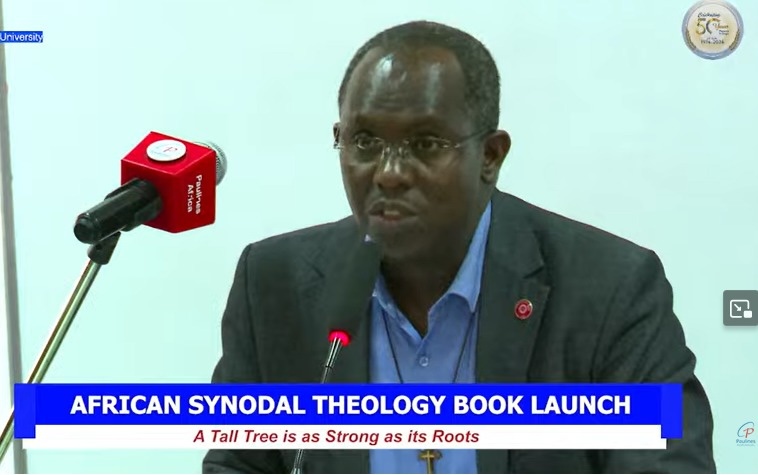
A new theological book arguing that Africa holds the key to renewing the Catholic Church’s synodal journey was officially launched on Wednesday, March 18, at Hekima University College (HUC) in Nairobi, in a hybrid event that brought together scholars, clergy, and faith leaders both in person and online.
Addressing participants on the rationale of the book, African Synodal Theology: A Tall Tree is as Strong as its Roots, Fr. Marcel Uwineza, the Principal of HUC and Associate Director for the African Synodality Initiative (ASI), described the synodality book as one that “offers a spirituality of deep listening to a wounded world.”
According to Fr. Uwineza who is one of the contributors for the book written by 12 authors and edited by Fr. Agbonkhianmeghe Orobator the Director of (ASI) and Dean of the Jesuit School of Theology of Santa Clara University in California, the new synodality book is “a prophetic voice and a major theological milestone for our time, and not merely an academic contribution.”
He added that the book is a resource the global Church “urgently needs at this moment of deepening polarization, declining trust, and institutional crisis.”
Expounding on the significance of the book during this moment in time, Fr. Uwineza, a member of the Society of Jesus (SJ), reflected on the fractured landscape of contemporary Church and global life, saying, “We are living in a divisive moment in the life of the Church and of the world. While the call to synodality that is walking together, listening, and discerning, has gained significant traction since the Second Vatican Council and more recently through the Synod on Synodality, the concept has been widely discussed but not sufficiently grounded in a lived context.”
Rather than treating synodality as an abstract ecclesial principle imported from Rome, Fr. Uwineza said, the book stresses that synodality must be rooted in culture, in spirituality, and in the lived experiences of ordinary people. In this regard, Africa, with its communal consciousness and rich spiritual heritage, offers exactly the soil in which synodality can, and should, grow.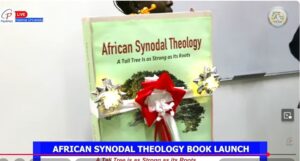
The Jesuit cleric underscored that synodality is neither an invention nor foreign to Africa. Long before it became a slogan in Vatican documents, he argued, its principles were already deeply embedded in African ways of being and living together.
Giving reference to the palaver, the traditional gathering space in Africa where communities used to deliberate and reach decisions together, Fr. Uwineza noted that this is a living symbol of synodal practice. He also highlighted the philosophy of Ubuntu, (I am because we are) as a theological foundation for the relational, participatory Church that synodality envisions.
In African life, he explained, “community is not optional but constitutive, dialogue is not merely procedural but relational, and decision-making is not imposed but discerned collectively.” This book, therefore, “shows that Africa does not need to import synodality. Africa embodies it,” he added.
Even though they celebrate Africa’s communal traditions, Fr. Uwineza disclosed that the work also highlights internal challenges to the Church on the continent. It critiques clericalism that silences the baptised, patriarchal structures that exclude women, and models of authority that concentrate power rather than share responsibility.
“It calls for a radical shift from a Church that speaks to people, to a Church that listens with the people,” he said, describing this not as cosmetic reform but as genuine ecclesial transformation. Authority, the book argues, must be understood not as domination but as a service that is accountable to the community it serves.
Furthermore, the HUC Principal said, the book insists on baptismal dignity, “the theological conviction that the Church is first and foremost a mystery and a people of God, not a hierarchy.”
This reframing carries profound practical consequences. Young people, Fr. Uwineza noted, “are not the future of the Church, they are its present. The laity are not passive recipients but co-responsible agents. Women are not auxiliary figures but protagonists.”
He stressed that the book is not only for Africa but is written from Africa to the world.
“If the global Church ignores this voice, it risks losing something precious. But if it truly listens, it may discover new life,” he said sharing his observation that the global Church is grappling with polarization, a new form of imperialism, the abuse crisis, a loss of institutional credibility, and declining participation among the faithful.
He concluded, emphasizing that synodality is not a destination to be reached, but rather a journey that requires embracing tension without fear, celebrating diversity without division, and accepting difference without exclusion.
“The future of the Church depends on its roots,” he said. “If the roots are solid, we have no reason to fear the wind, and Africa should be one of those vital roots.”