KENYA: Catholic Universities Challenged to Spearhead Theological Discussions on Synodality
Sr. Jecinter Antoinette Okoth, FSSA
Catholic institutions of higher learning in Kenya have been challenged to take concrete steps and have joint synodal seminars that would contribute original African theological reflection to the universal Church.
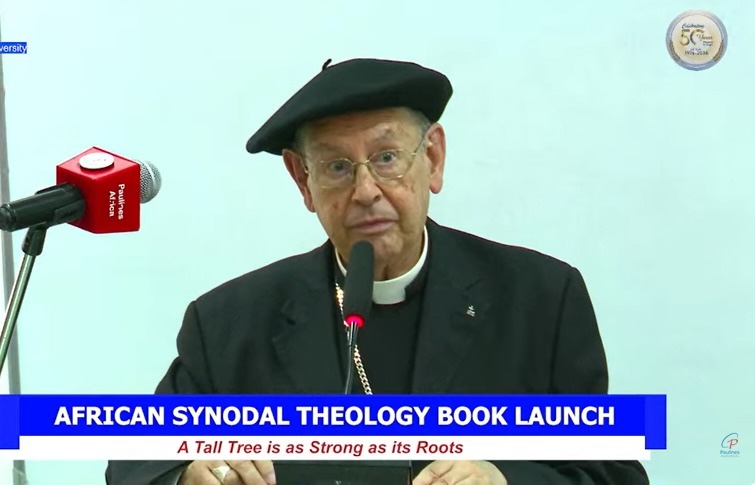
Bishop Rodrigo Mejía Saldarriaga, Vicar Apostolic Emeritus of Soddo, Ethiopia, shared this invitation with the universities during the book launch of African Synodal Theology: A Tall Tree is as Strong as its Roots on Wednesday, March 18, at Hekima University College (HUC), Nairobi.
The member of the Society of Jesus (SJ) and one of the founding members of HUC shared his concern that synodality may be reduced to a festivity, yet, it is something “born in the making,” no wonder the call of universities, including the Catholic University of Eastern Africa (CUEA), Tangaza University (TU), HUC, Consolata International University, Don Bosco Utume Theological College and other major seminaries in Kenya among others to have discussions on synodality.
He narrated that among the ten priority areas identified by Pope Francis following the Synod on Synodality is a comprehensive review of the entire structure of formation for priests. In this case, the Bishop argued that Nairobi’s cluster of theological institutions is uniquely positioned to respond to this universal call from a distinctly African vantage point.
“Why not invite the Bishops’ Conference of Kenya, together with all the authorities and formators of these faculties of theology and major seminaries in Kenya, and organize a synod to reflect and contribute to the universal Church?” he asked. The results, he suggested, could be submitted directly to the Synod Secretariat in Rome as a local contribution, giving African voices a concrete presence in the ongoing global conversation about how priests should be formed in the twenty-first century.
The fruits of such a synod, he envisioned, could offer a practical blueprint for contextualizing priestly formation in Kenya, shaping pastors who are truly equipped for the communities they serve.
Expressing more about his concern on the implementation of synodality, the Colombian-born Prelate said, “I have never seen an African celebration fail. No feast fails in Africa. All succeed. But the danger is that Synodality becomes a celebration, an event.”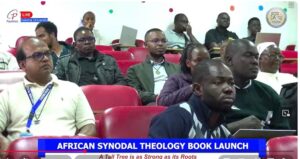
He noted that it has been over a year since the final phase of the Synod on Synodality concluded in Rome, and no concrete actions are being taken in the local Churches.
“Up to now, I don’t feel real actions or steps taken, unless at the level of some Small Christian Communities,” he said.
The Bishop pointed to a gap he had observed, noting that Canon Law, specifically Canons 460 to 468 of the 1983 edition, already provides a complete framework for organizing diocesan synods, yet he was not aware of a single parish or diocese that has organized a synod.
Despite his concerns, Bishop Rodrigo was clear that his critique came from a place of hope, not despair. He expressed genuine encouragement at the recent work of the Association of Member Episcopal Conferences in Eastern Africa (AMECEA), which he said has been making tangible progress.
“AMECEA has published and simplified the final document of the Synod for the people of God and has also produced a formation handbook on synodality,” he disclosed, and explained further, these are exactly the right first steps. “The problem is not the lack of will, it is the lack of preparation.”
He underscored that synodality demands a genuine and sometimes painful shift in mindset, saying, “We are passing from verticality to horizontality, and that is sometimes painful. People need to be prepared. We are not ready for immediate changes, but we have to start.”
Bishop Rodrigo’s remarks resonated with the spirit of the newly launched book, which argues that Africa must not wait to be told how to be synodal but must draw on its own deep roots to model what genuine synodal living looks like.