KENYA: Inter-Community Violent Attacks in Kenya’s Malindi Diocese
Communication office, Catholic diocese of Malindi
Residents of Chambuu village in Adu sub-county, Kilifi County, within the jurisdiction of Malindi catholic diocese in Kenya, are living in fear of retaliatory inter-community violence following the violent attack of one local resident by a suspected pastoralist on Wednesday 11.2.2026.
Violence erupted after a cattle herder from a neighbouring location refused to move his herd from a Chambuu village farm and was violently attacked by a suspected local resident.
The escalation led to the stabbing of three local men, the closure of Chambuu pre-primary school, and the burning of several thatched shelters belonging to the cattle herders’ community. Six people, including two children, are receiving treatment at Malindi District Hospital for injuries sustained during the retaliatory violence.
According to the local chief, Mr. Raymond Charo, approximately 100 people were forced to camp in the Kenya Assemblies of God (KAG) Church on Wednesday 11.2.2026.
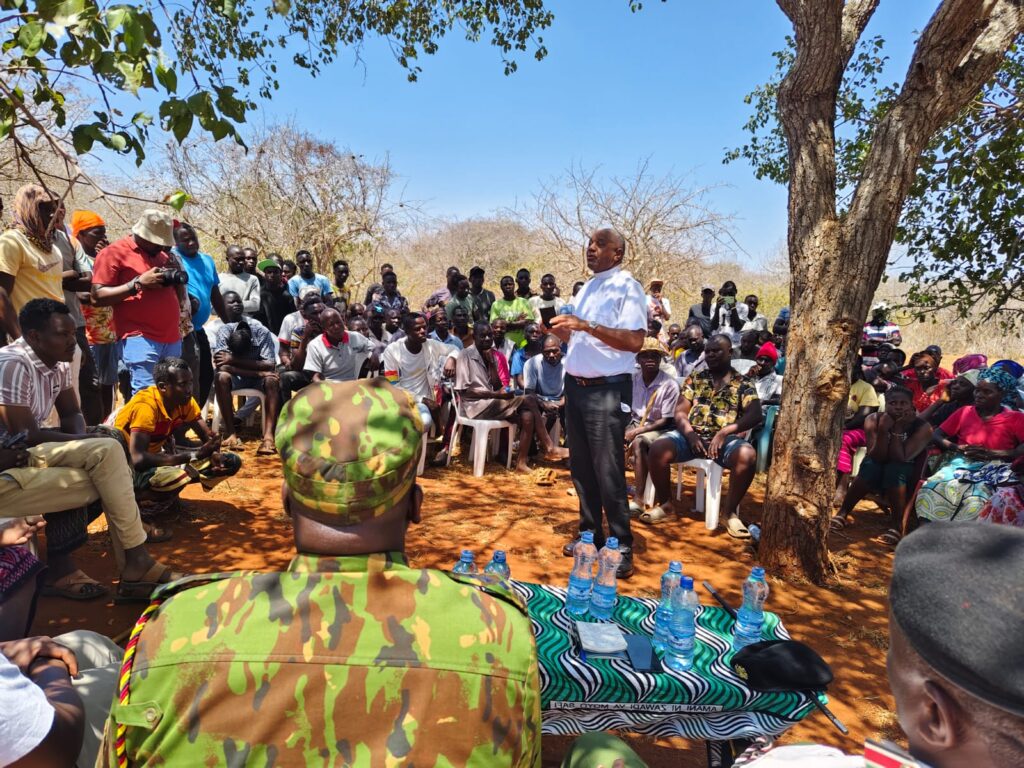
Bishop Willybard Lagho, together with local and administration leaders, held a reconciliation meeting on Thursday, February 12, 2025, in Hawewanje village, where both residents and the cattle herders’ community agreed to facilitate the arrest of individuals who committed such heinous acts.
The Directorate of Criminal Investigations (DCI) assured participants that the suspects have been identified and will soon face the full force of the law. Participants agreed to nominate a five-member committee to liaise with security officers and ensure peace prevails in the area.
Formation of Peace Committee
During the reconciliation meeting, participants reached a consensus to establish a peacekeeping committee. This committee will comprise five nominated members, each selected to represent the community’s interests and foster collaboration with security personnel. The key responsibility of these nominated individuals is to maintain open lines of communication with local security officers, ensuring that efforts are coordinated to uphold peace and prevent the recurrence of violence in the area. Through this joint initiative, both residents and cattle herders demonstrate their commitment to restoring stability and safeguarding the wellbeing of all community members.
Bishop Lagho invited both parties to reaffirm the previous arrangements under which the procedure for hiring grazing lands and designated corridors for cattle seeking water was established and strictly adhered to. Bishop said these attacks are isolated and only happen when cattle herders traverse Kilifi County to other locations in search of pasture during drought.
“Once it rains,” he said, “the social tensions subside.” Bishop Lagho attributed climate change as the underlying cause of these conflicts. Climate change, he noted, has resulted in reduced pasture for animals, water, and crop yields for both humans and animals.
Long-term solutions discussed include reducing cattle populations by herders, adopting feedlot systems with fewer animals that could still generate higher profits, and exploring alternative livelihoods. A follow-up meeting of Christian and Muslim leaders is scheduled for Tuesday, February 17, 2026. Bishop Lagho urged both communities to pray for rain and peace, especially during the seasons of Ramadan and Lent, which both begin on Wednesday, February 18.