KENYA: African Scholars, Pastoral Agents to Mark the Feast of St. Bakhita
Sr. Leonida Katunge and Fr. Cornelius Uche Okeke
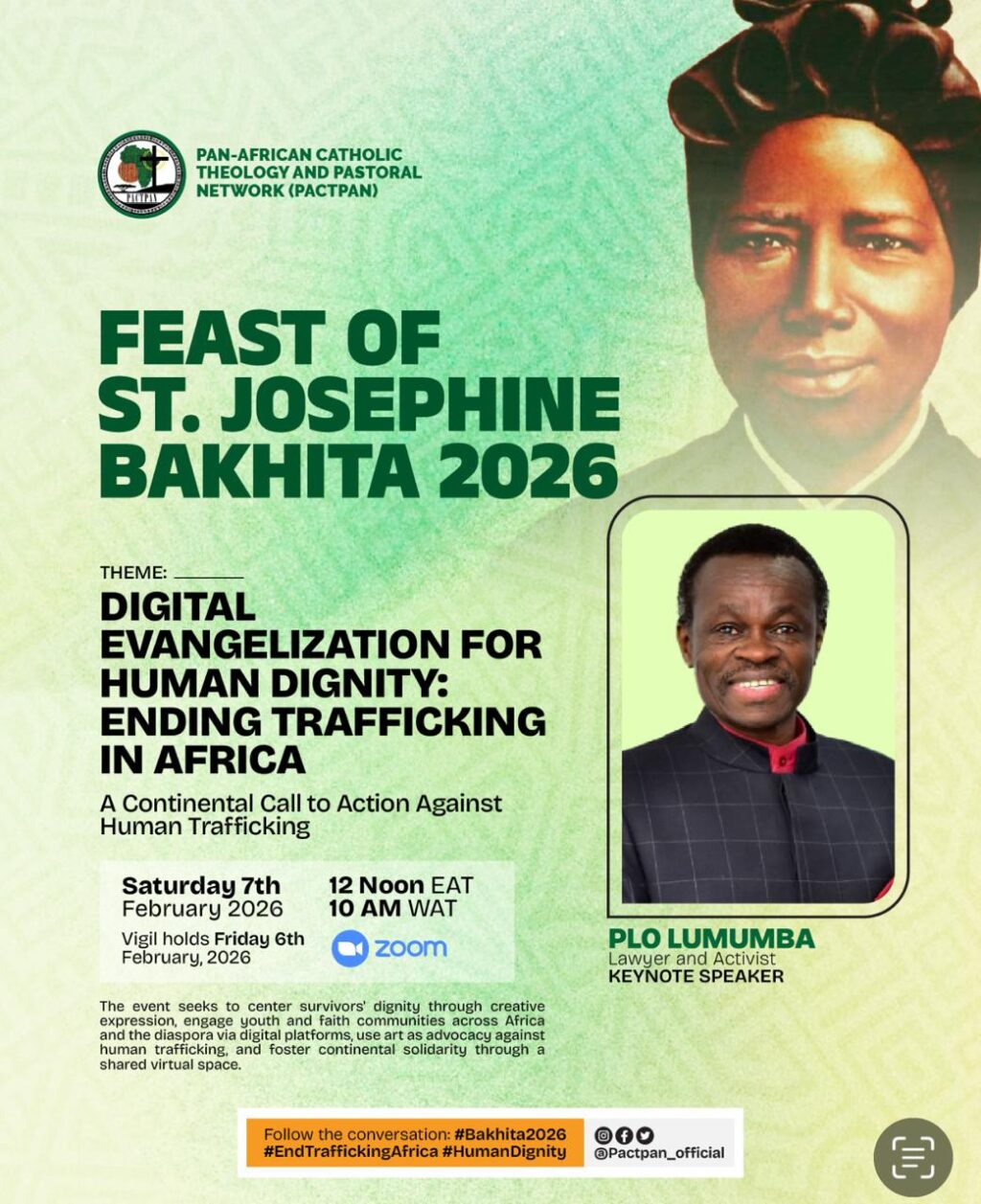
In preparation for the Feast of St. Josephine Bakhita, February 8, the Patron Saint of victims of human trafficking, members of Pan African Catholic Theology and Pastoral Network (PACTPAN) will come together for the second year in a continental digital commemoration under the theme: “Digital Evangelization for Human Dignity: Ending Trafficking in Africa.”
The feast, celebrated annually on February 8th, falls on a Sunday this year; hence, PACTPAN’s shifting it to Saturday, February 7. It will be preceded by a vigil on Friday, February 6, commencing with a Holy Mass and a candlelight prayer vigil, held locally across parishes, schools, religious communities, and youth groups, and spiritually united through shared digital resources.
The main celebrant will be Fr. Albert Kondemodre from Morocco, North Africa, assisted by Fr. Yannick Essengue from Congo Brazzaville. The vigil will honour victims and survivors of trafficking, invoke prayerful solidarity, and reaffirm the Church’s commitment to safeguarding human dignity.
On Saturday, the army and all teams involved will begin their activities at 8 am each at their respective centers or halls of choice. Then at 12 Noon EAT, the continent will gather online via Zoom and YouTube (PACTPAN) for a major awareness event featuring an address by Prof. Patrick Loch Otieno Lumumba, commonly referred to as PLO Lumumba, an Africanist and advocate for justice and human dignity.
His reflection intends to challenge systems that dehumanize and call for ethical responsibility in the digital age. This initiative recognizes that social media and digital platforms, often used by traffickers to deceive, recruit, and exploit, can and must be reclaimed as tools for protection, education, freedom, and hope.
Rooted in Catholic Social Teaching, particularly the principles of human dignity, solidarity, and the common good, this digital evangelization effort seeks to empower young people, promote safe migration, and expose the false promises used in trafficking networks.
Inspired by the life and witness of St. Josephine Bakhita, who transformed suffering into hope and freedom, this continental gathering affirms that what is used to harm can also be used to heal. Through prayer, advocacy, creative expression, and digital outreach, Africa raises a united voice to say no to trafficking and yes to dignity, freedom, and life.
More than 30 African countries are working to raise awareness and reach all parts of the continent. One of these countries is South Sudan, where Josephine Bakhita was born, and where she ended up being the Patron Saint of Trafficked persons.
Who is St. Josephine Bakhita?
St. Josephine Bakhita was born in 1869 in what is now South Sudan. She was 9 years old when she was kidnapped in Darfur, Sudan, by Arab slave traders and sold as a slave. She was mutilated and tortured by those who captured her and those who bought her. In her own words: “One day, I unwittingly made a mistake that incensed the master’s son. He became furious, snatched me violently from my hiding place, and began to strike me ferociously with the lash and his feet. Finally, he left me half dead, completely unconscious. Some slaves carried me away and laid me on a straw mat, where I remained for over a month.” A Turkish general who had a mistress bought Bakhita. The mistress beat her frequently and had Bakhita tattooed in over sixty places on her body. Those were deep razor cuts. To make the pain more excruciating for her, they rubbed the wounds with salt. These things happened even before she was a teenager. When she turned fourteen, an Italian diplomat brought her to watch over his little girl.
In 1888, the little girl in Bakhita’s care received religious instruction from the Sisters of Charity, the Canossian Sisters in Venice, Italy. As God’s providence works, Bakhita also received instruction alongside the little girl. When a crisis occurred, the Italian diplomat was to return to Africa with the family and their slave, but Bakhita refused. Instead, she preferred to stay with the sisters. She received the sacraments and joined the Canossian Sisters as a professed religious. In the convent, she prayed and worked as a cook, seamstress, sacristan, and doorkeeper. In all that had happened to her, as terrible as they were, she saw God’s hands leading her to where she finally was – a spouse of Jesus Christ. She forgave the slave traders and those who tortured her.
These are her words: “If I were to meet the slave-traders who kidnapped me and even those who tortured me, I would kneel and kiss their hands, for if that did not happen, I would not be a Christian and religious today.” She died in 1947 and was canonized in 2000. She is the patron saint of victims of human trafficking and symbolizes hope and resilience for those affected by this heinous crime.