ZAMBIA: Monze Diocese, Launches Synodality Songs to Foster Communion

Sr. Jecinter Antoinette Okoth, FSSA
To help the faithful connect with the Vatican’s call for a deeper and more inclusive Church, Zambia’s Monze diocese has launched synodality songs to bring together and strengthen communion among the clergy, religious, and lay faithful.
On Tuesday, January 27, the launch of the first ten synodality songs, broadcast live on Radio Chikuni, marked a creative milestone in the Church’s journey towards becoming a more participatory and listening community.
In an interview with AMECEA Online few days after the launch, Fr. Cletus Mwiila, the Synod contact person for Monze Diocese and initiator of the Synodality songs composition, disclosed that the launch brought together Catholics and non-Catholics alike in a Synodal conversation through music that touched the hearts of listeners across the diocese and beyond.
Fr. Mwiila, a delegate from the Association of Member Episcopal Conferences in Eastern Africa (AMECEA) attending the 2024 Parish Priests meeting in Rome, which discussed synodal experiences, shared global realities, and strengthened communal discernment, noted that the launch centered on four key messages.
“The songs are to ensure that the Synodal conversation is well understood; to invite the people of God convert to the Risen Lord; to invite everyone participate in the mission of Christ, the mission of the Church; and to promote unity and peace in our country,” the Zambian cleric narrated.
Besides, he added, “The implementation of Synodality through music is to inform, to form and to transform both at individual and community level.”
According to Fr. Mwiila, the ten synodality songs, which will be sung in Churches and Small Christian Communities (SCCs) and played on various radio stations, convey messages that touch people’s daily lives, addressing contemporary challenges while remaining firmly anchored in Sacred Scripture.
He noted that the liturgical composers were guided not only by Biblical texts but also by Church tradition, magisterial documents, particularly Pope Francis’s encyclical letter Laudato Si’, which emphasizes the call to preserve the environment and care for creation, and by their daily experiences, “bringing authenticity and relevance to the compositions.”
Asked whether the songs could be composed in English to reach a wider audience, Fr. Mwiila explained the cultural significance of using local languages. He disclosed that Zambia officially recognizes seven languages among its seventy-three ethnic groups, with citizens generally understanding various local languages. Thus, Churches use music from different dioceses, which creates a rich tapestry of liturgical expression.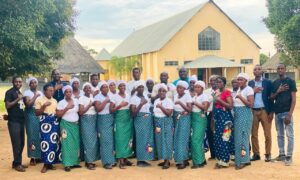
“Each culture determines how a song is composed within a local people’s culture,” he emphasized. “It might be difficult to compose the songs in English; however, it is important that the message in the songs is understood.”
He further explained that using local languages ensures the Synodality songs resonate deeply with worshippers, allowing them to express their faith in culturally authentic ways while maintaining the theological integrity of the messages.
Since the spirit of synodality is to amplify voices that are often unheard in ecclesial settings and to encourage listening to everyone in society, Fr. Mwiila acknowledges that, while the Monze Diocese might not have reached everyone during this initial phase of music composition, the participatory approach represents a significant step forward.
The openness to all who could compose, regardless of their status or position within the Church, reflects the radical inclusivity that synodality demands, he noted.
As the people of God are being encouraged to take a keen interest in the Synodality songs and use them as tools for evangelization, Fr. Mwiila stresses that this is not the end of the creative process but rather the beginning.
“This process does not mean we will be limited to these songs only. We encourage more composition of Synodality songs. What interests us most is seeing us begin to convert into a Church that not only hears what Jesus said, but also how he said it. It is a call to become a community that truly emulates Christ in our daily lives,” he explained.
Fr. Mwiila’s vision for the Synodality songs extends far beyond liturgical enrichment but as part of a transformative journey, an exodus toward freedom and authentic Christian living.
“The launch of the Synodality songs must lead us to walk together on a common path in our daily and ordinary life, illumined by the Risen Lord. To walk together is a journey, a transition, like the Exodus: a pilgrimage to freedom,” he shared his reflection, adding that, “As we walk together, our walk must be made beautiful by singing synodally for the Kingdom. It requires the courage to convert ourselves to the future God is preparing for us.”
Fr. Mwiila concluded that the process of composing synodal songs is ongoing, saying, “The Synod Committee will continue to promote a participatory process as a way of listening.”