VATICAN: Pope Leo XIV: St. Francis Offers Remedy to Modern Violence, Ecological Crisis
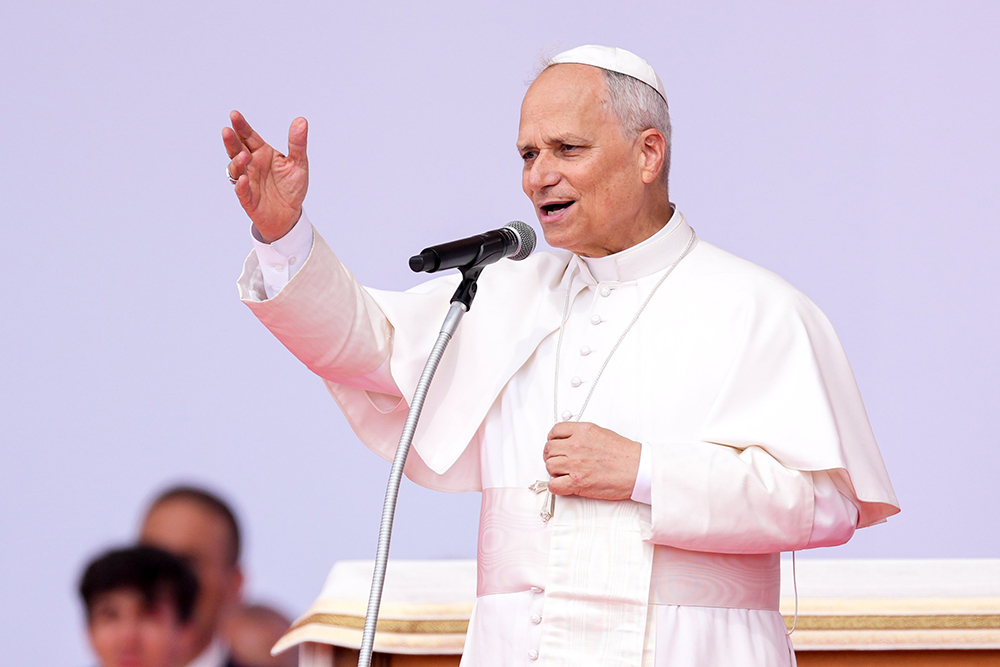
Pope Leo XIV gives a word of thanks at the conclusion of the Jubilee of Youth in Rome’s Tor Vergata neighborhood Aug. 3, 2025. The pope presided over the closing Mass and led the recitation of the Angelus. (CNS photo/Lola Gomez)
Sr. Jecinter Antoinette Okoth, FSSA
“The Franciscan vision of peace is not limited to the relations between human beings, but also embraces the whole of creation,” Pope Leo XIV stressed this message to the Ministers General of the conferences of the Franciscan family in his letter to mark the 800th anniversary of the death of St. Francis of Assisi, the Patron saint of ecology and of animals.
The Pontiff’s message, released Saturday, January 10, challenges the people of God to embrace the spirit of St. Francis of Assisi as a remedy to the violence, division, and ecological crises plaguing the modern world.
“Francis of Assisi remains a beacon of light for our troubled times. His life was a living sermon of peace; peace with God, peace with our brothers and sisters, peace with all creation,” reads part of the Pope’s message, emphasizing the saint’s radical witness to the Gospel that continues to speak across the centuries.
Pope Leo XIV’s letter comes at a time when conflicts rage across continents, social divisions persist, and the environmental crisis threatens the planet’s future. The Holy Father, therefore, sees in St. Francis of Assisi not merely a historical figure to be admired, but a prophetic voice whose message of reconciliation and care for creation offers concrete pathways forward.
“In an age of crusades and conquest, Francis chose dialogue,” Pope Leo XIV notes. “When others took up swords, he embraced the cross. When the world valued gold, he treasured only Christ.”
The letter highlights further St. Francis’ historic journey to Egypt during the Fifth Crusade, where he courageously crossed enemy lines to meet with Sultan Malik al-Kamil. This extraordinary encounter, the Pope emphasizes, demonstrates that authentic Christian witness requires the courage to ‘build bridges rather than walls, to seek understanding rather than dominance.’
“Francis did not go to Egypt as a conqueror, but as a humble servant of the Gospel of peace. He shows us that true evangelization begins with respect, listening, and genuine human encounter,” Reads the letter in parts.
The Pope emphasized universal fraternity by seeing all people as brothers and sisters, regardless of faith, nationality, or social status. This echoes his broader teaching on human solidarity and recalls St. Francis of Assisi’s own revolutionary vision of a community bound not by power or wealth, but by mutual love and service.
He challenges the people of God, full of individualism, competition, and consumerism, contrasting it with St. Francis of Assisi’s embrace of simplicity and radical identification with the poor and marginalized.
“In Francis, we see that true freedom comes not from possessing more, but from needing less. His poverty was not deprivation, but liberation, freedom to love without reservation, to serve without calculation, to give without counting the cost,” he notes.
He calls on religious communities, parishes, and Catholic institutions worldwide to examine whether they are truly living the Franciscan charism of closeness to the poor, or whether they have allowed themselves to be guided by the spirit of worldliness and comfort.
In an appeal to young people, Pope Leo XIV presents St. Francis as a model of Christian living that speaks to the search for meaning and authenticity that characterizes youth today.
“Francis was young when he heard God’s call to ‘rebuild my church. He responded with total generosity, without fear, without calculation. Young people today are called to the same courageous ‘yes’ to God’s dream for humanity,” the Pope wrote.
He encouraged the young people not to be discouraged by the magnitude of the world’s problems, but to embrace St. Francis of Assisi’s spirit of joyful, creative service. He pointed to the countless young people already engaged in peacebuilding, environmental activism, and service to the poor as signs of hope and continuation of the Franciscan legacy.