UGANDA: Ugandan Church Leaders Call for Greater Lay Participation as Vatican II Decree Marks 60 Years
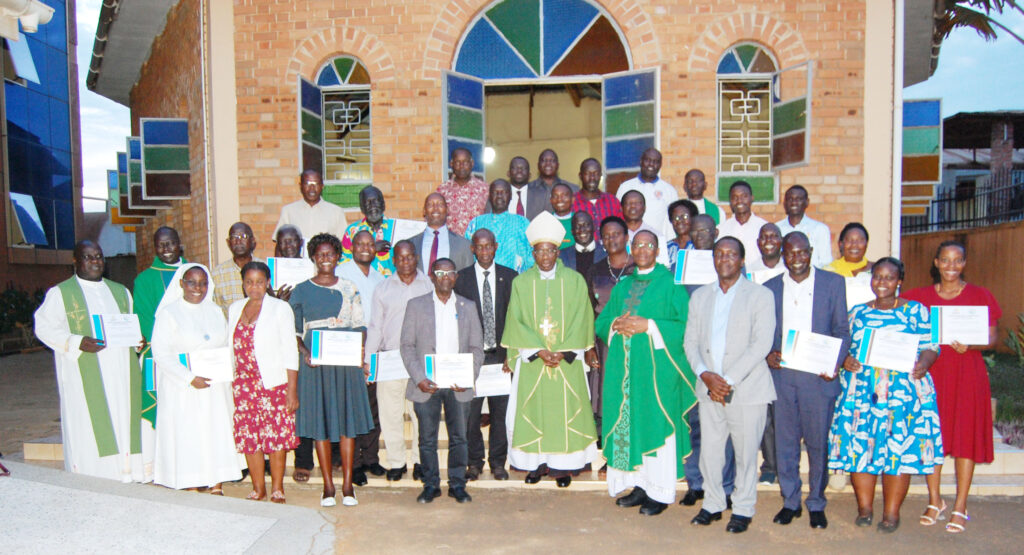
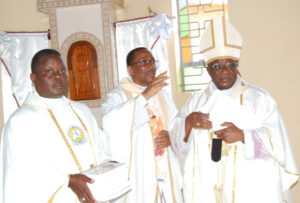
Participants sharing a photo moment with Archbishop Augustine Kasujja (wearing a mitre) after the closing ceremony. Photo by Mathias Mazinga
Mathias Mazinga
The Catholic Church in Uganda commemorated the 60th anniversary of the Vatican II Decree on the Apostolate of the Laity with a three-day study conference that brought together 50 pastoral coordinators and lay leaders from dioceses across the country to examine the document’s continued relevance for contemporary evangelization.
The conference, held November 17-20, 2025, at Ulrika Guest House in Kisubi, Wakiso district, focused on Apostolicam Actuositatem, the 1965 decree promulgated by Pope Paul VI that reaffirms the laity’s participatory role in the Church’s mission of spreading the Gospel and renewing the temporal order.
Archbishop Paul Ssemogerere of Kampala, who doubles as the chair of the Lay Apostolate Commission of the Uganda Episcopal Conference (UEC), opened the conference by emphasizing that the decree remains more relevant today than when it was promulgated. He urged priests, religious, and laity to work together to enhance the Church’s mission of evangelization and social development.
“Through Apostolicam Actuositatem, the laity are invited to give credible witness to Christ in all circumstances; on the streets, in workplaces, and in society,” Archbishop Ssemogerere said during the opening mass. “They are encouraged to renew the church and society through their exemplary life and work. The Church needs Christian witnesses who put their heart, talent, leadership, and fidelity to the mission of Christ.”
The Archbishop challenged participants to embrace ongoing formation and warned against the tendency to rely exclusively on priests for leadership and church construction. He called for authentic collaboration and partnership in renewing the temporal order and transforming society, religion, and culture.
On his part, the Apostolic Nuncio Archbishop Augustine Kasujja, who presided over the closing mass, used a striking metaphor to illustrate the importance of lay involvement: “Without the engagement of the laity, the Church advances abnormally, like a kangaroo. The people of God, I mean the clergy, the religious, and the laity, must work in communion to overcome the challenges of evangelization in the modern world.”
Archbishop Kasujja pointed to the Uganda Martyrs as a perfect example of effective lay participation, noting how Joseph Mukasa Balikuddembe and Andrew Kaggwa maintained the Church’s presence when pioneer missionaries fled to Tanzania due to persecution in 1882. When the missionaries returned three years later, the number of catechumens had grown tremendously.
The decree, one of the 16 official magisterial documents of the Second Vatican Council, depicts the laity’s involvement in ecclesial mission as a right and responsibility that Christians receive by virtue of their baptismal priesthood. According to the document, the laity can fulfill this responsibility through the sanctification of their daily life, professional work, and general social transformation.
Multiple speakers throughout the conference emphasized different aspects of lay participation. Fr. James Ssendege from Masaka Diocese advocated for greater lay involvement, noting, “Our foundation of the Church in Uganda is laity-based. The Uganda Martyrs were lay people. Most of the Church’s land was also donated by laypeople. So, the laity is important in the mission of the Church.”
Rev. Sr. Mary Justine Naluggya stressed the need for communion and listening. “If we are not in communion, participation will not be there. So, we should nurture a culture of listening and working together. The laity should no longer see themselves as mere spectators but active participants in the Church,” she said.
Other speakers addressed specific areas of concern. National youth leader Prossy Namata requested greater involvement of young people in the Church’s planning processes. Hon. Jovino Akaki, veteran politician and Head of the Laity of Lira Diocese, urged Catholics to embrace political leadership, saying, “We must embrace and provide political leadership. Catholics are still shy about politics, yet it is in politics that policies are brewed.”
Fr. Ambrose Bwangatto, Pastoral Coordinator of Kampala Archdiocese, discussed the historical context and theological road to the decree during the conference, which also featured presentations from Fr. Frederick Tusingire, Director of the Lay Apostolate Commission at Uganda Catholic Secretariat.
The workshop ran under the theme “Pilgrims of Hope: Reflecting on the Past, Journeying Together into the Future.”